EFIA is a bilingual international school offering a high-quality French curriculum, enriched by New Zealand’s curriculum and pedagogical approaches. It is a primary school (i.e., years 1 to 6).
Below is a comparative presentation of the French and New Zealand class level correspondences:
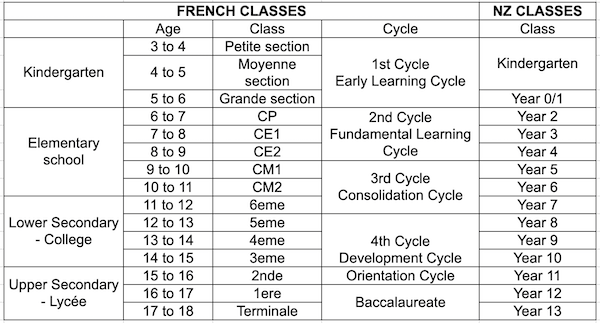
In the French curriculum, education is organised into five learning areas during the 1st Cycle (Grande section / Year 0/1):
- To mobilise language in all its dimensions
- To act, to express, to understand through physical activity
- To act, to express, to understand through artistic activities
- To build the first tools to structure thought
- To explore the world
From Cycle 2 on, the curriculum is structured around five core domains that define the major educational goals:
Languages for thinking and communicating: Students are taught how to understand and express themselves while using 4 types of language:
- French;
- Other modern or regional languages
- Mathematical, scientific, and technological languages;
- Language of the arts and the body.
Methods and tools for learning: Students are taught how to:
- Learn, individually or collectively, in class or outside of class,
- Access information and documents,
- Use technological methods,
- Lead individual or collective projects,
- Organise their studies and the knowledge they have accumulated.
Personal and civic development: This domain focuses on learning societal life, collective action, and citizenship through moral and civic education, respectful of personal choices and individual responsibilities. The core values and principles embedded in the Constitution are passed on.
Natural and technical systems: This area is centred on the scientific and technical understanding of Earth and the Universe, aiming to develop curiosity, observation skills, and problem-solving abilities.
Representations of the world and human activity: Students develop spatial awareness of geography and history by understanding societies within their respective environments. They learn to interpret human cultural expressions and gain a deeper understanding of the contemporary world.